AI governance & operations

See what your AI agents are doing.

Atalaia maps every business flow and AI agent you run. It shows what each one can reach, what data crosses it, what it costs, and what needs a person right now. Standalone from day one, and sharper as you connect more.

See how it works
Visibility across every flow
Governance and guardrails
Real cost, in real time
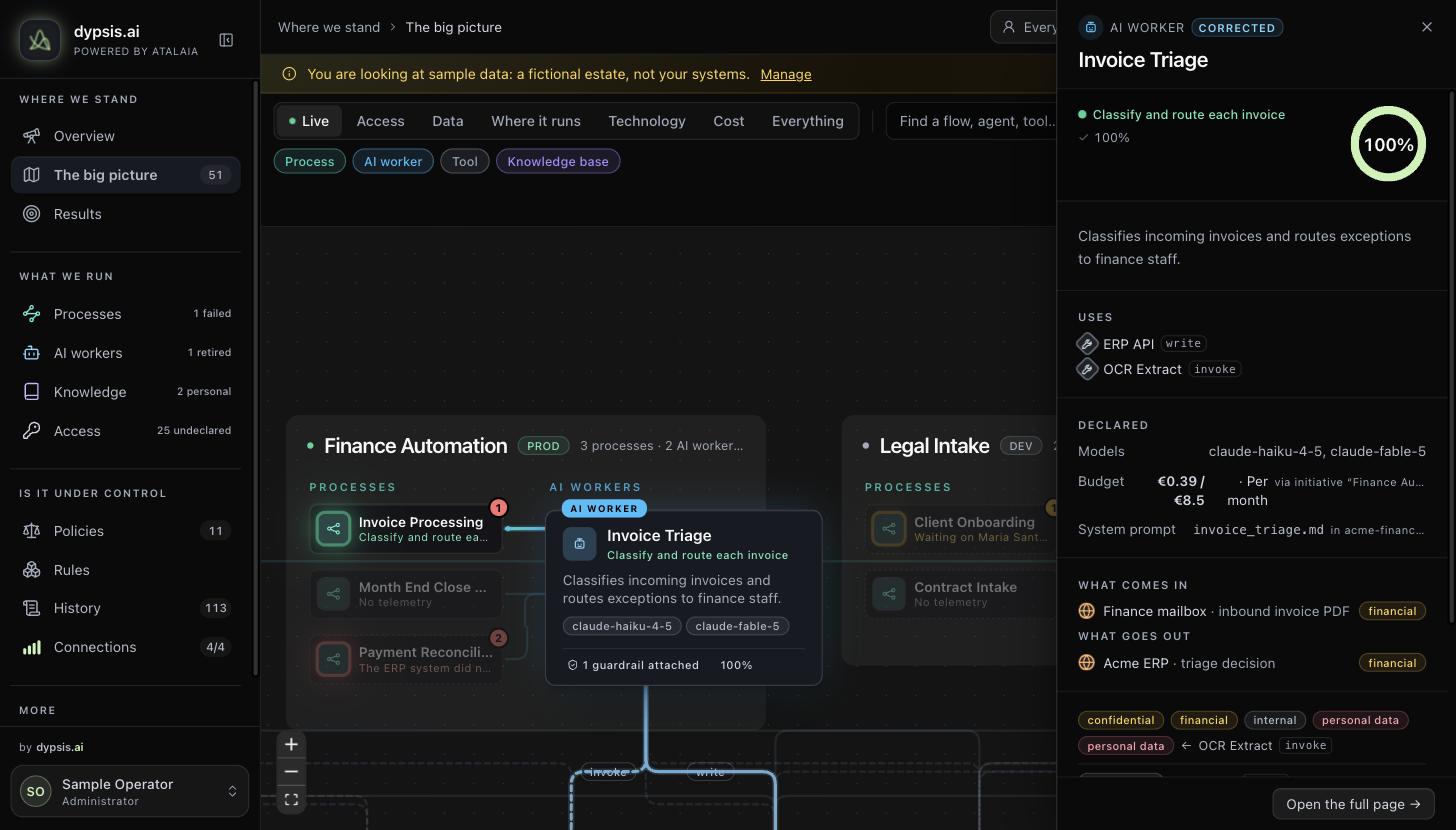
The Atalaia estate map: every initiative, process and AI worker on one canvas, with a single AI worker opened to show what it reaches, what it costs and what data crosses it. A fictional sample estate.
Sample estate
Scroll to explore

You cannot govern what you cannot see.

AI agents now touch real systems and real data across your business. Most teams cannot say what is running, what it reaches, or what it costs. Atalaia gives you that picture on the first day.

Standalone first

Works with zero integrations. Gets more useful as you enrich it.

Declare what you run and you already get the full governance surface. Every rung above is optional, and you control each one.

  1. 1
    Day one: the floor, not a fallback
    Declared

    You get the full governance surface on day one: structure, permissions, data contracts and exposure, from knowledge of your own estate alone.

    Requires nothing

  2. 2
    Scanned

    You get evidence, discovered entities and drift: queued as decisions that never overwrite what you declared.

    A working tree you mount: source never stored

  3. 3
    Observed

    You get live status, run history, failures in plain language and real spend, reported by the agents themselves.

    One key, one snippet

  4. 4
    Assisted

    You get enriched findings and a registry that answers questions from any MCP client.

    Credentials you hold

What is missing is reported as missing. “No telemetry” is a real, grey state, and Atalaia never turns absence into good news.

In, through, out

Everything feeds one registry. Everyone reads from it.

Every input pushes into the same registry, under the same provenance rules. Nothing a person declared is ever silently overwritten. People read the picture in the portal; machines ask for it over MCP and policy checks.

  1. 01

    What feeds it

    Declare, import, scan, report. Minutes to start, no connectors to build.

  2. 02

    One registry

    Every kind of entity, one provenance. Nothing a person declared is silently overwritten.

  3. 03

    Who reads it

    The map, exposure, decisions and spend for people. Answers over MCP and policy checks for machines.

The real thing

One estate. Four ways to read it.

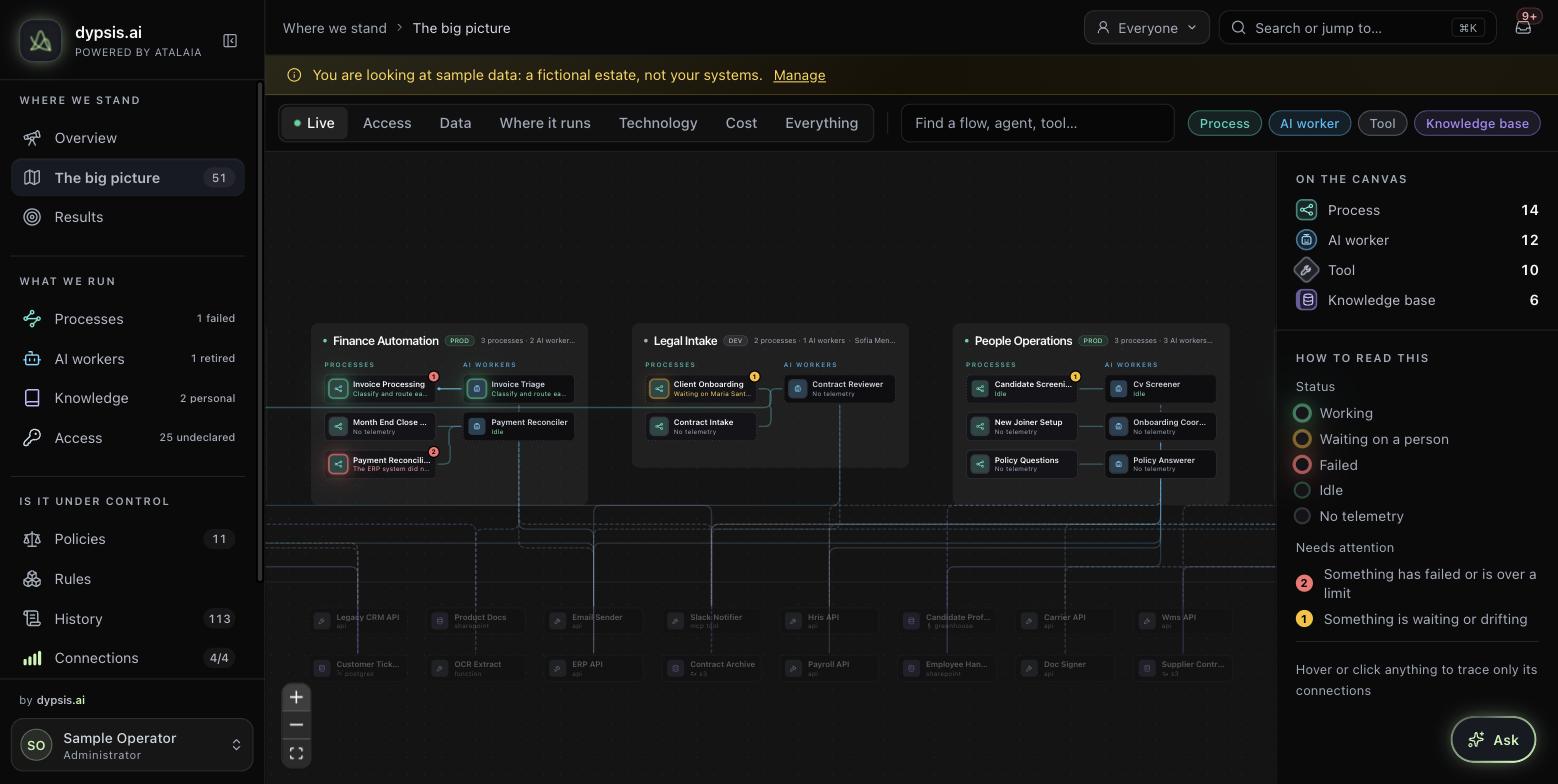
Every other picture on this page is an illustration. These are screenshots of the running product: the same estate on the same canvas, redrawn by changing one lens.

The estate map on the Live lens: initiatives side by side with their processes and AI workers, and what is working, waiting on a person, failed, or reporting nothing at all.
LiveSample data: a fictional estate, not a client's systems.
One place to govern

Everything your estate touches, in one honest picture.

The estate map

Initiatives, agents, flows and the tools and knowledge they reach. Click any node to see what it touches.

Permissions

What every agent can reach, and why. The permission web made legible instead of buried in config.

Guardrails & budgets

Policies that attach to the estate and answer an enforcement point the moment it asks.

Data exposure

What data crosses each flow, by category, so exposure of personal data is a fact you can see, not a guess.

The decision inbox

Everything waiting on a person, from conflicts to drift to blocked runs, as one queue in plain language.

Run history

Every run, its steps and its cost, with failures explained for the business, not just the engineer.

By design

What Atalaia never does.

The boundaries are the product. They are why it is safe to point at your whole estate.

  • 01Never
    authors

    It records agents that exist; it never creates, configures or launches one.

  • 02Never
    drives

    No retry, cancel, trigger or enable against your agents. It observes; it does not act.

  • 03Never
    pulls

    No connector reaches into another vendor's system. Others integrate with Atalaia, on your terms.

  • 04Never
    holds source

    Evidence is pointers: repo, path, line, SHA. Your source code is never stored.

  • 05Never
    fakes liveness

    A status is computed from events that arrived, never from their absence.

  • 06Never
    bricks on licensing

    An expired licence changes what the portal reports, never what it does.

Push, not pull

Other systems integrate with Atalaia.

Five stable primitives, each one you control. No vendor connectors, no importers to maintain.

Your agents, wherever you build them:

OpenAIAnthropicGeminiMistralLangChainLlamaIndexCrewAIn8nMakeGitHubGitLabMCP
  1. POST /api/registry 201

    Register entities directly from your own tooling.

  2. POST /api/estate/import 200

    Import a whole estate, flows included, as one manifest.

  3. POST /api/events 202

    Report runs from any agent with the vendored emitter.

  4. MCP /registry ok

    Let an MCP client read the registry and answer questions.

  5. POST /api/guardrails/check · /api/budgets/check 200

    Your enforcement point asks before acting; Atalaia answers.

atalaia · portal
registeredimportedreportingansweringchecked
Runs in your infrastructure.No credentials handed over.No connector to break.Your data leaves only if you choose.

atalaiaa·ta·LIE·anoun, Portuguese

Atalaia is the Portuguese word for the watchtower on the coast, from the Arabic aṭ-ṭalāʾiʿ, “the lookouts”. Someone stayed awake so the town could sleep, and the tower never sailed the ships.

It is not an acronym. It will never stand for Autonomous Tracking & Learning AI Analytics.

See your estate the way Atalaia does.

Book a demo and we will show you a full estate the way Atalaia sees it: the map, the ladder, the inbox.

We connect nothing to your systems for a demo.